October Allocutio 2025
Aspects of Humility
Fr. Paul Churchill, Concilium Spiritual Director
Whoever among you wishes to be the greatest among you, let him be like the least and the servant of all (Mt 20:26-27).
The great example of Our Lady in showing us humility always needs revisiting because we can so easily, in so many ways. slip into some form of pride. And as Ch. 33, n.7 of the Handbook points out it can do great damage to the Legion.
Hear St. Vincent de Paul: “That is why it should be a prime concern of ours to get away from the monstrosity of pride. But if it already has a place in our hearts, then a suitable way of getting rid of it immediately, following Our Lord’s advice already quoted, would be to try, through genuine humility, to have a less inflated opinion of ourselves and to want always to have the lowest place.” And in choosing Nazareth (Can anything good come from that place Jn 1:46) and the foot of the Cross, that is Mary’s example to us.
Hear St. Vincent de Paul again, “All of us should as well make a particular effort to repress the first feelings of envy which can arise when the reputation, public estimation, and prominent works of other organisations are better than ours. We must definitely convince ourselves that it does not matter by whom Christ is preached, as long as he is preached and that as such—sometimes even more—grace and merit come to us when we are pleased at other people’s good work as would come if we had done it ourselves with self-congratulation or from a less worthy motive.”
And that might be hard for some to swallow but an aspect of our legionary approach is to allow space for other groups and corroborate with them. And if they do better than us, let us praise God, not be jealous.
St Francis de Sales should be listened to since he reconverted Geneva to the faith after it had almost gone with Protestantism. “Can we ever pass judgment on our neighbour? No, never … It is the part of an unprofitable soul to amuse itself with examining the lives of other people.” According to St. Francis, those who have a tendency to judge others usually do so for one of several reasons: either (a) they have a naturally bitter disposition; (b) they are arrogant and proud, thinking that they raise their own honour when they look down on other men; (c) they like to show their intelligence by philosophizing about other men’s behaviour; or (d) they are acting out of jealousy or anger, such as in the case of a betrayed lover.
The cure for all of these poisons, St. Francis says, is to “drink the sacred wine of charity.” When we are faced with a situation where a neighbour’s actions are questionable, we must always choose the most charitable explanation possible, St. Francis says. Even if a sin is obvious, we must still imitate Jesus, who pleaded the ignorance of those who crucified Him, “Father they know not what they do. “When we cannot excuse a sin,” St. Francis says, “let us at least make it worthy of compassion by attributing the most favourable cause we can to it, such as ignorance or weakness.”
St. Francis also strongly exhorts Christians to avoid slander at all costs, as it is “a form of murder. …At one stroke [the slanderer] stings and poisons the listener’s ear and the reputation of the man he is speaking against.” Even if we have seen a neighbour commit a vice, we are in danger of falsehood if we call him a drunkard, a glutton, an adulterer, or make any other accusation on the grounds of what we witnessed. And if we find ourselves putting someone else down or are thinking or speaking ill of another, what is really going on in the depth of our hearts?
“Since God’s goodness is so immense that a single moment suffices for us to ask for and receive his grace, what certainty can we have that a man who yesterday was a sinner is such today? Hence we can never say that a man is wicked without exposing ourselves to the danger of telling a lie. If we must say something it is only that he did such and such a bad deed, that he lived a bad life at such a time, or that he does ill at present. We must never draw conclusions from yesterday to today, nor from today to yesterday, and still less to tomorrow.”
If we must condemn another’s vice for the benefit of either the person spoken about or the person spoken to, we still must be very careful to spare as much as possible the person in whom the vice is found, telling only the necessary truth, nothing less and nothing more. Often it is the exaggeration that does the real damage. And when emotions arise there is always the risk of exaggeration. Or we may have a bad habit of embellishing something, a trait we need to tackle.
Today is mission Sunday. Our Lord said, “the meek will inherit the earth.” There are many examples of humble people who flew below the radar, so to speak, but today are lauded because of their good lives and are an inspiration (e.g. in Dublin we can think of Matt Talbot). The person who wants to go out bravely and aggressively and brashly to be a St Paul and wave the flag in public, has to be careful of why and what he is doing. His own glory or that of God?
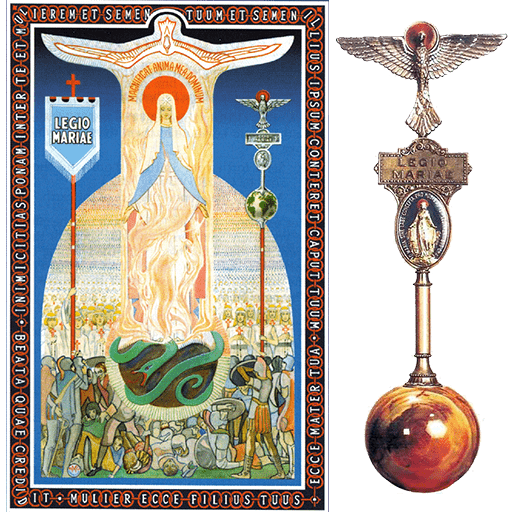
For us in the Legion of Mary, Our Lady is the standard. Let us reflect on her standards of humility and let God work in us as he wants, being aware that we are sinners, weak, of no importance and with limited capacities. Let us hand ourselves to him in our nothingness for he who is almighty can do great things for us. Amen.